Understanding How Hospitals Manage Financial Flow
Healthcare is not only about patient care.
Behind every consultation, laboratory test, surgery, and pharmacy transaction, there is a financial process that helps hospitals maintain operations and generate revenue.
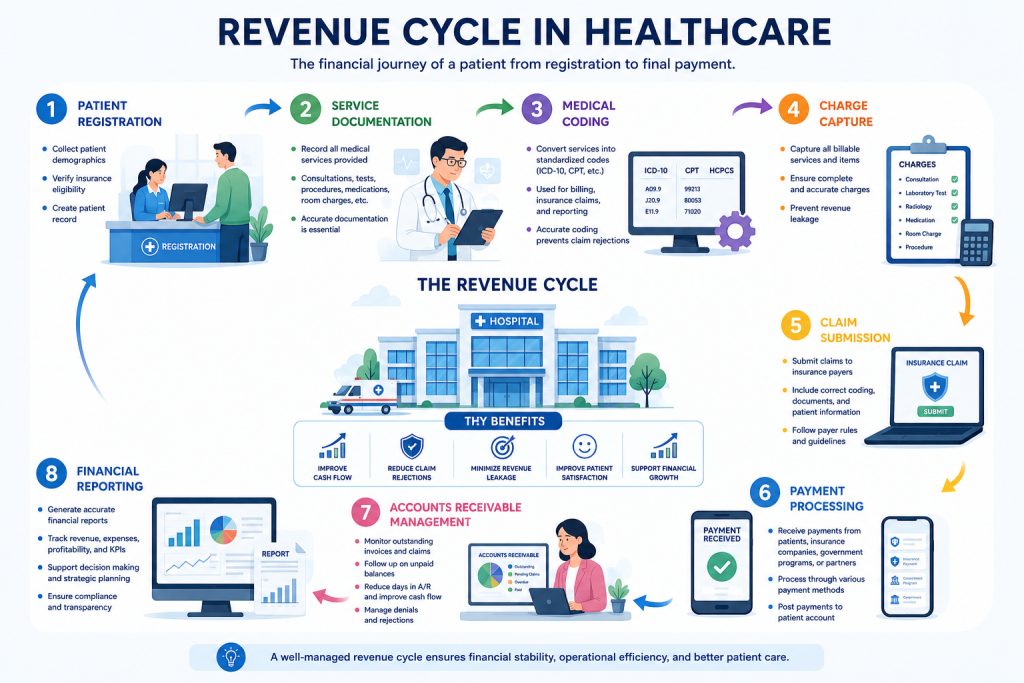
This process is known as the Revenue Cycle.
In healthcare, the revenue cycle is one of the most important operational systems because it connects:
- patient services
- billing
- insurance claims
- payments
- accounting
- financial reporting
Without a proper revenue cycle process, hospitals may experience:
- delayed payments
- insurance claim rejections
- financial losses
- cash flow problems
- operational inefficiencies
Modern hospitals rely heavily on digital systems to manage the entire healthcare revenue cycle efficiently.
What Is Revenue Cycle in Healthcare?
Revenue Cycle Management (RCM) is the process of tracking and managing all financial activities related to patient services — from patient registration until final payment collection.
In simple terms:
Revenue cycle is the complete financial journey of a patient inside the healthcare system.
The cycle starts when a patient schedules an appointment and ends when the hospital receives full payment.
Main Stages of the Healthcare Revenue Cycle
A hospital revenue cycle usually consists of several important stages.
1. Patient Registration
The revenue cycle begins when the patient registers.
Hospitals collect:
- patient identity
- insurance information
- contact details
- guarantor information
- appointment data
Accurate registration is extremely important because incorrect data may cause:
- claim rejection
- duplicate patient records
- billing errors
Modern systems usually include:
- digital registration
- insurance verification
- online appointments
- automatic eligibility checking
2. Service Documentation
After registration, healthcare providers record all medical services provided to the patient.
Examples:
- doctor consultations
- laboratory tests
- radiology examinations
- surgeries
- medications
- inpatient services
Accurate documentation is critical because every service affects:
- billing
- insurance claims
- financial reports
3. Medical Coding
Hospitals convert medical services into standardized billing codes.
These codes are used for:
- insurance claims
- government reporting
- tariff calculations
- financial analysis
Incorrect coding may lead to:
- rejected claims
- underpayment
- compliance issues
Medical coding is one of the most sensitive areas in healthcare finance.
4. Charge Capture
Charge capture means recording all billable services into the billing system.
Examples:
- medicine usage
- room charges
- laboratory fees
- doctor fees
- medical procedures
If services are not captured properly, hospitals may experience:
- revenue leakage
- inaccurate invoices
- missing payments
Modern billing systems automate charge capture using:
- EMR integration
- pharmacy integration
- laboratory integration
- real-time transactions
5. Claim Submission
For insured patients, hospitals submit claims to insurance providers.
The claim process usually includes:
- claim validation
- tariff checking
- supporting documents
- coding verification
Common challenges:
- incomplete data
- invalid insurance eligibility
- coding mismatches
- rejected claims
Efficient claim management is very important for hospital cash flow.
6. Payment Processing
After claims are approved or invoices are generated, payments are processed.
Payments may come from:
- patients
- insurance companies
- government healthcare programs
- corporate partners
Modern hospitals now support:
- digital payments
- virtual accounts
- QR payments
- payment gateways
- installment payments
7. Accounts Receivable Management
Not all payments are received immediately.
Hospitals often manage:
- unpaid invoices
- pending insurance claims
- installment balances
- overdue receivables
Accounts receivable management helps hospitals:
- monitor cash flow
- reduce bad debt
- improve collection performance
8. Financial Reporting
At the end of the cycle, hospitals generate financial reports.
These reports help management analyze:
- revenue performance
- profitability
- claim status
- departmental income
- operational efficiency
Modern healthcare systems usually provide:
- real-time dashboards
- automated accounting journals
- revenue analytics
- export to Excel and PDF
Common Revenue Cycle Problems
Many hospitals still face operational and financial challenges such as:
Claim Rejections
Insurance claims may fail because of incorrect data or coding problems.
Revenue Leakage
Some services are performed but never billed properly.
Slow Billing
Manual workflows can delay patient discharge and payment collection.
Data Integration Problems
Disconnected systems may cause missing transactions or duplicate billing.
Manual Reporting
Spreadsheet-based reporting increases risk of human error.
Why Revenue Cycle Management Is Important
A strong revenue cycle system helps hospitals:
- improve financial stability
- reduce claim rejection
- accelerate cash flow
- minimize billing errors
- increase operational efficiency
- improve patient satisfaction
Without proper revenue cycle management, even large hospitals may struggle financially.
Modern Revenue Cycle Technology
Today, many healthcare organizations use:
- cloud-based hospital systems
- integrated billing platforms
- real-time dashboards
- automation
- AI-assisted claim validation
- centralized healthcare ERP systems
Technology helps hospitals reduce manual work while improving financial accuracy.
Final Thoughts
Revenue Cycle Management is one of the most important foundations of modern healthcare operations.
It ensures that hospitals can:
- provide medical services efficiently
- manage financial transactions accurately
- maintain healthy cash flow
- support long-term operational growth
As healthcare becomes more digital, hospitals increasingly need integrated revenue cycle systems that are:
- automated
- scalable
- accurate
- secure
- connected in real time
A strong revenue cycle process not only improves hospital finances but also helps create a better experience for both patients and healthcare providers.
